
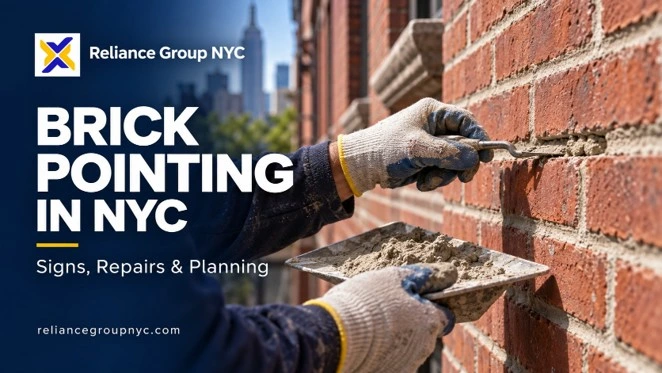
A small gap between two bricks can raise a surprisingly big question: does the wall need a simple mortar repair, or is the gap a sign of something else? Brick pointing in NYC involves renewing deteriorated mortar joints in existing brickwork. It can help reduce water entry through damaged joints and improve the appearance of the wall. The right starting point is a condition assessment that identifies where the mortar has failed and whether other repairs are needed.
If your building has missing mortar, recurring damp patches, or repairs that keep cracking, avoid choosing a solution from a photograph alone. Record the location and history of the problem, then ask a masonry professional to explain the cause and the proposed scope.
This guide helps NYC homeowners, landlords, co-op boards, and property managers understand the repair options, prepare for an assessment, compare estimates, and review the finished work. Reliance Group NYC provides brick pointing services for residential and commercial properties.
What Is Brick Pointing and How Is It Different From Repointing?
Mortar forms the joints between the bricks. Repointing removes defective mortar and replaces it with new material in properly prepared joints. In everyday searches, people use “brick pointing,” “repointing,” and “tuckpointing” for similar work. Tuckpointing can also describe a decorative finish that creates the appearance of fine joint lines. Terminology varies, so your contract should describe the actual work rather than rely on a service name.
When discussing brick repointing NYC projects, ask one direct question: “Will the deteriorated mortar be removed and the joints prepared before the new mortar is installed?”
That answer helps distinguish a defined repair from a proposal that promises only to freshen the surface. The Brick Industry Association’s repointing brief explains the terminology and the importance of identifying defective joints.
Signs That Deserve a Brickwork Assessment
Start with visible observations. You do not need to diagnose the wall yourself to provide useful information to the person assessing it.
Missing or Crumbling Mortar
Look for gaps, loose fragments, and visibly eroded joints. Compare the affected area with nearby brickwork, and photograph the location from a safe position. Avoid scraping the wall or pulling material out to test it.
Cracks That Return After a Repair
Document when the repair was completed and when the crack reappeared. A repeated defect deserves a discussion about what the earlier work addressed and what remains unresolved.
Damp Patches Near an Exterior Wall
Record whether the patch appears after rain, where it starts, and whether it changes over time. Include photographs of both the interior symptom and the corresponding exterior area where you can safely see it.
Loose Bricks or Changes in the Wall’s Shape
Loose masonry, a bulging wall, or falling material needs prompt professional attention. Stay away from the affected area and alert the building manager. A routine quote request should not be the only response to a possible hazard.
The National Park Service’s Preservation Brief 2 identifies deteriorating mortar, cracks, loose masonry, and dampness as reasons to investigate. It also emphasizes correcting the underlying cause before repointing.
Read the Pattern Before Choosing the Repair
A useful assessment connects the symptom with its location and history. “The wall leaks” provides less information than “the bedroom patch appears below the rear window after wind-driven rain. Use this observation table when preparing your request. These are discussion prompts, not diagnoses.
| What you notice | What to record | What to ask during the assessment |
| Missing mortar in one area | Wall location and overview photographs | Is the defect localized or part of a wider pattern? |
| Dampness around a window | Timing, interior location, and previous repairs | Which surrounding details should be investigated? |
| A crack that reappears | Earlier scope, repair date, and dated photographs | Is further investigation needed before another repair? |
| Damage near the roof edge | Visible location and leak history | Does the repair need coordination with roof or parapet work? |
| Different mortar patches | Dates and descriptions of previous work | How will the new repair area and finish be defined? |
White Deposits Need Interpretation
White crystalline deposits may be efflorescence: salts left behind when water evaporates from masonry. Their appearance alone does not identify the water source or prove that the entire wall needs repointing.
Ask whether the deposits are new, recurring, or associated with another visible defect. Cleaning and repair are separate decisions. The Brick Industry Association’s efflorescence guide explains how water carries soluble salts to the surface.
Will Repointing Stop a Brick Wall From Leaking?
It may help when defective mortar joints are an entry path. It cannot be assumed to correct every leak in the building envelope. For a recurring leak, ask the assessment team to explain which findings support the proposed repair. If the cause is still uncertain, discuss what investigation is needed before committing to a large construction scope.
A useful proposal should connect three things: the observed defect, the repair intended to address it, and the method for reviewing the result. “Repoint the wall” is incomplete if nobody has explained why that work matches the complaint. The Brick Industry Association’s maintenance guidance discusses several distinct maintenance tasks, including repointing, sealant repairs, flashing, drainage openings, and brick replacement. Those tasks serve different purposes.
For example, imagine a rear wall with deteriorated joints and a separate concern around a window. Ask for those items to be described individually. This makes the estimate easier to understand and helps you track which part of the complaint each task addresses. For projects involving a wider exterior scope, explore Reliance Group NYC’s facade renovation services.
Does the Whole Wall Need Repointing?
Not automatically. Defective joints should be identified before deciding how much work is appropriate. Sound original mortar should not be removed simply to make an entire elevation look newly repaired.
Ask the professional assessing the wall to explain the boundary of the proposed work. A marked photograph or elevation drawing is more useful than a general description such as “repair the back.”
Questions About a Localized Repair
For a small repair area, ask how the work will tie into adjacent joints, how the finish will be reviewed, and whether the contractor has checked the surrounding masonry. Keep the approved area in the project record.
Questions About a Larger Repair Area
If an entire elevation is proposed, ask what observations support that decision. Clarify whether the quantity represents all joints in that area or only defective joints within it. This distinction also matters when comparing bids. A contractor pricing selected repairs and another pricing an entire wall may both produce reasonable estimates for very different projects.
Choosing Mortar That Suits the Existing Brickwork
The strongest mortar is not necessarily the most suitable repair material. Existing brick and mortar need to be considered together, particularly on older buildings. Replacement mortar should be compatible with the masonry and the existing mortar. Appearance also matters: color, texture, and joint finish can change how the repaired wall looks.
Ask the project professional what information supports the material selection. Depending on the building, that discussion may include its age, existing materials, repair history, and whether further analysis is worthwhile. A generic promise of “premium cement” does not answer the compatibility question. The NYC Landmarks Preservation Commission’s restoration guide addresses both physical compatibility and visual matching for historic masonry repairs.
Request a Sample Before Approving Extensive Work
Ask whether a sample area is appropriate and who will approve it. Agree on its location, the review stage, and how the accepted sample will be recorded. Review the sample in the context of the surrounding wall rather than judging only a close-up photograph. If appearance matters to a board or owner, involve that decision-maker before the contractor proceeds across a larger area.
Write down what the sample approval covers. It might establish the finish and visual standard, while the project professional separately reviews material suitability and preparation requirements.
What to Expect During a Professional Repointing Project
Owners benefit from understanding the sequence without needing to direct the masonry work themselves. Preparation, mortar placement, finishing, and protection should follow the project requirements.
Assessment and Scope
The work starts with identified repair areas and an agreed approach. Any related defects should have their own description and responsibility.
Joint Preparation
Defective mortar is removed and the joints are cleaned. The method should protect the surrounding bricks and create suitable conditions for the new material.
Mortar Placement and Finishing
Mortar is placed and compacted into the prepared joints, then finished to the specified profile. A superficial covering over defective material is not equivalent to this sequence.
Protection and Review
Ask how the work will be protected while the mortar develops and when the completed repairs will be reviewed. Weather planning and curing belong in the contractor’s method, not in an improvised decision on the final day.
For a technical overview, see the Brick Industry Association’s maintenance note. Your project’s professional specifications should determine the actual methods and requirements.
How Much Does Brick Pointing Cost in NYC?
A useful brick pointing cost NYC estimate needs a defined wall area, known access conditions, and a clear repair scope. A single online rate cannot explain the price of every project.
Rather than starting with the cheapest number, ask what each estimate includes. The following questions help make the cost discussion specific to your property.
How Is the Quantity Measured?
Clarify whether the estimate uses square feet of wall, lengths of joints, or a fixed amount for a described repair area. Ask how openings and excluded sections are treated.
If the quantity is provisional, agree on how it will be verified. A price based on an estimated area should identify what happens if the measured work differs.
What Access Is Included?
Discuss how the team will reach the work, what access equipment is included, and how long it is expected to remain. Confirm whether installation, removal, and any relevant approvals are part of the proposal.
Tell the contractor about a narrow rear passage, limited roof access, neighboring property concerns, or restrictions on delivery times before the estimate is finalized. Ask how each constraint affects the plan.
Which Repairs Are Separate?
If the assessment identifies damaged bricks or another component needing work, ask whether those items are included, separately priced, or excluded pending further investigation. This prevents an estimate for mortar repair from being mistaken for a complete solution to every visible exterior defect.
What Happens When Conditions Change?
The proposal should explain who authorizes additional work, how it is priced, and what documentation accompanies the request. Ask for an agreed process before construction begins.
For a co-op or managed property, set an approval threshold and identify the person who can respond. A contractor should not have to guess whether the superintendent, manager, or board controls a change order.
What Does the Total Include?
Request a breakdown covering the repair scope, access, protection, cleanup, and any professional or approval responsibilities included in the appointment. Check exclusions as carefully as inclusions.
No verified standard price or project-specific warranty was supplied for this article. Obtain those details directly from Reliance Group NYC for your building.
Comparing Brick Pointing Estimates Without Missing the Scope
Before requesting several bids, give each contractor the same information. Share the repair locations, available assessment findings, photographs, known access constraints, and any material requirements already specified.
Then compare the proposals using a consistent set of questions.
| Proposal item | What should be clear |
| Repair area | Locations, quantities, and whether work is selective or comprehensive |
| Materials | Proposed mortar and who confirms suitability |
| Preparation | How the joints will be prepared and bricks protected |
| Access | Equipment, expected duration, installation, and removal |
| Related repairs | Included items, allowances, and exclusions |
| Changes | Approval process and pricing method |
| Completion | Review, cleanup, records, and written warranty terms if offered |
A lower total is useful only when you understand what has changed. If one proposal omits access or leaves brick replacement undefined, ask for clarification before choosing it. Keep the contractor’s answers with the estimate. Verbal explanations can be forgotten when a different team member takes over the project.
An Illustrative Comparison
Suppose Proposal A describes selected joint repairs on the rear elevation. Proposal B describes repointing the entire rear elevation and replacing specified damaged bricks.
These hypothetical proposals cannot be compared by dividing their totals by the same wall area. First establish which scope the assessment supports, then ask both contractors to price that scope. This example is a planning illustration, not a Reliance Group NYC quotation or customer project.
Do You Need a Permit for Brick Repointing in NYC?
NYC Department of Buildings guidance lists brick repointing among certain facade work that does not require a DOB permit. However, the complete project may include other work or access arrangements with separate requirements. For an individual landmark or a building within a historic district, check LPC requirements as well. DOB and LPC are separate approval questions; an exemption under one process does not establish the answer under the other.
Ask the project professional to review the building’s status and full scope before work starts. Record who will handle required applications and what approvals must be in place before mobilization.
Consult the official DOB facade project requirements and LPC restoration guidance. Requirements should be checked for your particular project. Reliance Group NYC also lists landmark renovation services for owners planning work on historic properties.
How Long Will the Project Take?
Ask for a schedule that separates preparation, approvals where applicable, access installation, repairs, protection, and completion review. The number of days spent placing mortar is only one part of the project.
Instead of requesting a universal turnaround, ask the contractor to identify the assumptions behind the proposed dates. Are materials selected? Is access confirmed? Is the repair quantity established? Does anyone still need to approve the sample?
Decide Who Can Approve the Next Step
Assign one person to coordinate routine questions. Give that person a clear route for decisions that require owner or board approval. If a sample needs board review, arrange the review date before work depends on it. If neighboring access needs consent, address that early rather than assuming it will be available on arrival.
Discuss Weather and Protection
Ask how weather conditions will be assessed, who decides whether work proceeds, and how unfinished areas and completed joints will be protected. Avoid demanding an exact finish date without understanding those assumptions. A clear schedule should explain how changes will be communicated, including any effect on access duration.
Plan for Occupied Buildings
Agree on working hours, delivery routes, resident notices, and any temporary restrictions. Tell residents where to direct questions and how they will receive updates. A short notice can state the work area, planned dates, access changes, and contact person. Update it when the plan changes so residents are not relying on an outdated promise.
Choosing Brick Pointing Contractors in NYC
When comparing brick pointing contractors NYC, ask for evidence that helps you understand how they approach this type of work. Request examples of relevant repointing projects, an explanation of the proposed material selection, and a written scope for your building. Photographs are more useful when the contractor explains what was repaired and how the work resembles your project.
Ask who will supervise the crew, who answers technical questions, and how the work will be reviewed. Confirm applicable credentials and insurance directly rather than relying only on a general marketing description. Discuss warranty terms in writing if a warranty is offered. Clarify what is covered, the duration, exclusions, and how a concern is reported. Avoid interpreting a broad promise of “lasting protection” as a specific contractual commitment.
Reliance Group NYC’s published services include brick pointing and exterior restoration. Its brick pointing page provides a starting point for discussing the condition and scope of your property.
What to Prepare Before Requesting an Assessment
Create a simple folder that someone unfamiliar with the property can understand. Include:
- The building address and the wall or elevation involved.
- Overview photographs and closer views taken from safe locations.
- Dates and locations of recurring leaks or cracks.
- Earlier repair proposals, invoices, and relevant reports.
- Known access restrictions and resident considerations.
- Landmark information or professional specifications already available.
- Your preferred contact and any target dates that need discussion.
Label photographs by location. “Rear elevation below second-floor window” gives the assessor more useful context than “IMG_0047.”
If you do not know the cause, say so. A neutral description such as “damp patch after rain” is more helpful than presenting an unconfirmed diagnosis as a fact.
Reviewing the Finished Work and Keeping Records
Agree on completion criteria before construction begins. Ask who will review the repairs, which documents will be provided, and how outstanding items will be recorded. At closeout, compare the completed work with the approved locations and scope. Keep photographs, any accepted sample record, the material information provided, and the final invoice together.
If the original complaint involved a leak, ask how follow-up observations will be handled. Record whether the symptom recurs and share specific dates and locations. A wall looking freshly repaired is not, by itself, evidence that every water-entry path has been resolved. For work connected with a facade inspection report, clarify the inspector’s follow-up responsibilities separately. The construction invoice should not be treated as a substitute for required professional review or filing. Reliance’s FISP services pages explains its published inspection support services.
Give future managers a concise handover: what was repaired, where, when, by whom, and which issues remain open. That record can make the next assessment more useful.
Frequently Asked Questions About Brick Pointing in NYC
Is Brick Pointing the Same as Repointing?
The terms are often used for renewing existing mortar joints. Repointing specifically describes removing defective mortar and replacing it. Ask your contractor to define the work in the proposal so the service name does not create confusion.
How Do I Know Whether My Building Needs Repointing?
Missing or deteriorating mortar, recurring cracks, and dampness justify an assessment. Provide photographs and a history of the symptoms. A professional should identify which joints need repair and whether another issue needs investigation.
Can Repointing Fix Every Exterior Leak?
No. It can address defective joints, but the repair needs to match the actual water-entry problem. Ask what findings support the proposed scope and how the result will be reviewed.
Should All Old Mortar Be Replaced?
Age alone should not define the repair quantity. Ask the assessor to identify defective joints and explain the proposed work area. A larger scope needs a clear condition-based reason.
Will the New Mortar Match the Wall?
Matching should be discussed before work begins. Ask about color, texture, joint finish, and an appropriate sample. Record who approves the sample and what standard the rest of the work should follow.
How Much Does Brick Repointing in NYC Cost?
The estimate depends on the defined repair quantity, access, materials, and related tasks. Request a building-specific proposal with clear inclusions and exclusions. Compare contractors against the same scope rather than relying on an isolated online rate.
Can Work Be Planned Around Residents?
Discuss working hours, deliveries, access changes, and communication before mobilization. Agree on a named contact and an update process. The contractor should explain which parts of your request can be accommodated within the work plan.
What Should I Do if a Crack Returns?
Document the location, date, and earlier repair details. Contact the responsible contractor or project professional and request a review of the cause. Avoid repeatedly authorizing the same cosmetic patch without understanding why it fails.
Does a Landmark Property Need Special Consideration?
Yes. Check the property’s designation and applicable LPC requirements before choosing materials or starting work. The project professional should confirm the approvals and repair approach for the specific building.
Can Reliance Group NYC Help With Brick Pointing?
Reliance Group NYC lists brick pointing for residential and commercial buildings among its services. Send the address, repair locations, available photographs, and previous reports so the team can discuss the next step for your property.
Discuss Your Brickwork With Reliance Group NYC
Start with a clear description of what you have noticed, rather than guessing how much of the building needs repair. A useful assessment should help you understand the affected areas, the proposed work, and the decisions needed before construction.
For mortar joint repair NYC inquiries, contact Reliance Group NYC. Share your building address, photographs taken from safe locations, and any previous repair information to begin a focused discussion about your brickwork.