
If you own or manage a New York City building higher than six stories, FISP Cycle 10 should be on your maintenance calendar. The immediate questions are straightforward: when is your report due, who needs to inspect the building, and what should you do about repairs identified in an earlier report?
Start with three pieces of information: your building’s tax block number, its latest accepted facade report, and any outstanding repair completion dates. These tell you which filing window applies and which conditions need attention before you plan the next inspection.
The Facade Inspection and Safety Program, commonly called FISP or Local Law 11, requires covered buildings to undergo periodic exterior examinations and file a technical report. A DOB-approved Qualified Exterior Wall Inspector, or QEWI, is responsible for the examination and report. An ordinary contractor’s estimate does not replace that process.
This guide explains the FISP Cycle 10 NYC deadlines and gives building owners a practical way to organize inspection records, compare repair proposals, coordinate access, and follow the project through to its final filing status.
For an overview of the support available from Reliance Group NYC, visit our Facade Inspection and Safety Program services page.
FISP Cycle 10 Deadlines Find Your Building’s Filing Window
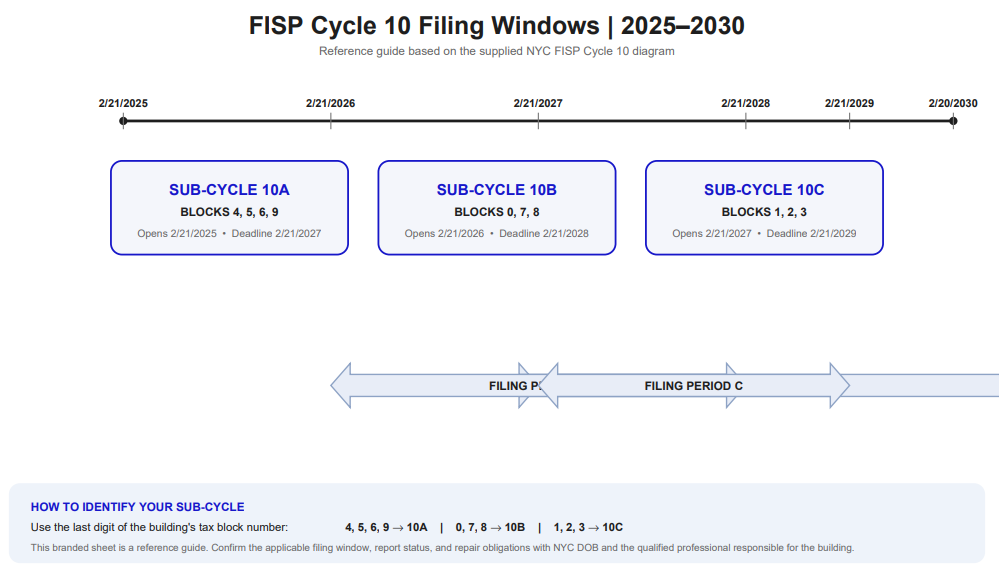
FISP filing windows are assigned using the last digit of the building’s tax block number. Use the block number, rather than the street address, ZIP code, or lot number.
The standard Cycle 10 windows are:
| Sub-cycle | Last digit of tax block number | Filing window opens | Filing window closes |
| 10A | 4, 5, 6, or 9 | February 21, 2025 | February 21, 2027 |
| 10B | 0, 7, or 8 | February 21, 2026 | February 21, 2028 |
| 10C | 1, 2, or 3 | February 21, 2027 | February 21, 2029 |
As of September 2026, the standard 10A and 10B windows are open. The standard 10C window opens in February 2027. Ask your QEWI about any applicable filing exceptions, particularly if the building has a missing previous report.
Keep the filing deadline and repair deadline separate
A report deadline tells you when your Cycle 10 filing must be made. A repair completion date tells you when a particular condition must be corrected. Opening a new filing window does not cancel an earlier repair obligation.
For example, a building in sub-cycle 10B may have a February 2028 filing deadline and an earlier repair date in its existing report. Planning everything around February 2028 could overlook the more urgent obligation.
Put both types of dates in your building calendar. Give each task a named person responsible for tracking it, and keep the supporting report available to everyone managing the project.
Does Your Building Need a Local Law 11 Inspection in NYC
NYC DOB states that FISP applies to buildings higher than six stories. Covered properties require exterior wall and appurtenance examinations every five years, with a technical report filed through DOB NOW: Safety.
Appurtenances are elements attached to, or associated with, the exterior wall. Depending on the building, these can include balconies, railings, cornices, and other exterior features that require evaluation.
Confirm your building’s coverage with a qualified professional and current DOB information. Avoid relying on a casual visual count of floors when the property has an unusual layout, additions, or conflicting records.
Buildings outside FISP still need safe exterior conditions. Being outside the cyclical filing program does not make loose masonry or falling material acceptable.
For background on the local law terminology used by property owners, see Reliance Group NYC’s Local Law 10/11 services. For the program’s official scope, consult NYC DOB’s facade and Local Law guidance.
Who Handles the Inspection, Repairs, and Filing
A facade project involves several responsibilities. Clear roles help prevent the familiar situation where an owner assumes the contractor is handling a filing while the contractor assumes the inspector is waiting for instructions.
The building owner or property manager
The owner should organize the records, engage the necessary professionals, authorize work, and monitor the deadlines. A property manager can coordinate the day-to-day tasks, but the project still needs a clear approval process.
Before work starts, decide who can approve a change order, who communicates with residents, and who checks filing updates. If board approval is necessary, include meeting dates in the schedule.
The Qualified Exterior Wall Inspector
The QEWI evaluates the exterior, determines the facade classification, and takes responsibility for the FISP report. This role requires DOB approval; a general engineering or construction description alone is insufficient.
Ask for the name of the QEWI responsible for your building and clarify the inspection, documentation, reporting, and follow-up services included in the appointment.
The facade repair contractor
The contractor carries out the agreed repair work according to the project requirements. Depending on the scope, that may involve masonry repairs, replacement of deteriorated components, or other exterior restoration work.
The contractor and QEWI should agree on how completed repairs will be documented and reviewed. A finished construction invoice is useful for your records, but it does not establish the building’s accepted FISP classification.
Understanding Safe, SWARMP, and Unsafe Reports
Your report classification affects the next steps. Read the report’s specific findings and dates alongside the status label.
Safe
A Safe classification indicates that the exterior meets the relevant condition standard. Keep the accepted report and continue the maintenance program recommended for the property. A filed report is a point in your building’s maintenance history, not a reason to stop looking for new problems.
Safe With a Repair and Maintenance Program
SWARMP means Safe With a Repair and Maintenance Program. The report identifies conditions that need correction to avoid becoming unsafe.
Complete the work by the SWARMP completion date specified by the QEWI. DOB states that the same unrepaired condition cannot remain SWARMP across consecutive cycles.
Build a repair schedule around that actual date. Avoid treating “SWARMP” as permission to leave the work until the next inspection campaign.
Unsafe
Unsafe conditions require immediate public protection and prompt coordination with the QEWI. DOB’s compliance guidance sets a 90-day repair requirement, with extension requests handled through the required process when applicable.
Do not assume that extra time is automatic. Ask the QEWI to explain the relevant dates, required submissions, and responsibilities for your building.
Review the official NYC DOB facade compliance guidance with the professional responsible for your report.
A Practical FISP Cycle 10 Checklist Before the Inspection
Preparing records early gives the inspection team a clearer picture of the building. It also helps you separate a new problem from one that appeared in the previous cycle.
1. Collect the latest accepted report
Keep the full report, rather than a screenshot showing only the classification. Review the condition descriptions, location diagrams, photographs, recommended work, and repair dates.
If your management team has changed, confirm that the previous manager or owner transferred the complete file. Missing records can make it harder to establish what was identified and what was repaired.
2. Gather evidence of previous repairs
Organize contracts, invoices, permits where applicable, progress photographs, and relevant professional correspondence. Label documents by building elevation and work area where possible.
For example, “west elevation, third-floor lintel repairs” is more useful than a folder called “building work.” Clear labels help the project team connect an invoice with a specific condition.
3. Confirm ownership and account details
Check that ownership information is current and that the appropriate owner or representative can complete the required account and consent steps. DOB’s filing guidance explains the owner’s eFiling consent requirement.
Handle this before the filing becomes urgent. A report can be delayed by administrative details even when the field examination has already taken place.
4. Discuss access with the QEWI
Ask what access arrangements the examination requires. Identify roof access, restricted areas, occupied spaces that may be affected, and any neighboring-property coordination that needs discussion.
Do not select an access system solely because it appears cheaper. The inspection professional and project team need to determine a suitable approach for the property and scope.
5. Share the building’s recent problem history
Prepare a short log of recurring leaks, visible exterior changes, past falling material, or repairs that did not resolve the original complaint. Include approximate dates and locations.
The log is supporting information for the examination. It should not replace the QEWI’s assessment or become an owner’s attempt to assign a facade classification.
6. Allow time for review and corrections
Plan for examination, report preparation, owner consent, submission, and review. DOB reviews submitted reports and may require corrections; submission and acceptance are separate stages.
The official FISP filing requirements explain the process and common reporting omissions.
What Should a Facade Repair Proposal Include
If the examination identifies repairs, use a defined scope before comparing contractors. Otherwise, a lower price may simply reflect fewer repairs, different access assumptions, or missing closeout work.
Ask for a written proposal that explains:
- The locations and quantities of work, with estimated quantities identified clearly.
- The proposed repair methods and materials.
- Access equipment and public protection included in the price.
- Permit and professional coordination responsibilities.
- Work exclusions and assumptions.
- How concealed conditions and quantity changes will be handled.
- Proposed sequencing and expected access duration.
- Documentation and review needed at completion.
Compare the proposals line by line. If one contractor includes a complete repair area and another includes only visible patches, they are not pricing the same scope.
Discuss the cause of deterioration
A recurring defect deserves a discussion about why it returns. The repair team should consider the underlying issue rather than relying on appearance alone.
For example, a deteriorated masonry area may need investigation of nearby joints, flashing, or other details. The appropriate solution depends on the actual findings and repair design.
NYC DOB’s facade FAQ specifically states that repairs must address underlying causes, rather than only cosmetic deterioration. For work involving exterior restoration, explore Reliance Group NYC’s facade renovation services.
Match masonry work to the approved scope
Where the project includes mortar-joint work, discuss the specified materials, preparation, and quality review with the project team. Repointing is a defined repair task; it should not be assumed to resolve every facade defect.
Reliance Group NYC’s brick pointing services are relevant when masonry joint repairs form part of the recommended work.
Confirm permits and landmark considerations
Ask the design professional to identify the work that needs permits and whether Landmarks Preservation Commission approval applies. Do not assume that the requirements for a neighboring building are identical to yours.
Record the applicable approvals in the project schedule so the contractor, inspector, and owner are working from the same assumptions.
How to Plan the Budget Without Guessing at Repair Costs
There is no single meaningful FISP repair price for every NYC property. A cost discussion needs the building’s condition, access requirements, and proposed scope.
Separate your budget into inspection and reporting, professional repair planning, construction, access and protection, and follow-up documentation. This makes it easier to see which costs relate to the examination and which relate to remediation.
Ask how long access equipment is assumed to remain in place and what happens if the work takes longer. Discuss weather-sensitive tasks, material availability, resident access, and approval lead times as planning variables.
For uncertain quantities, request a clear measurement and pricing method. A documented unit rate or change-order process is more useful than a vague promise that everything unexpected will be dealt with later.
If the building needs board or financing approval, begin that discussion while the scope is being developed. Waiting until the contractor is ready to start can create avoidable scheduling problems.
Keep Residents, Staff, and the Project Team Informed
Facade repairs can affect entrances, windows, roof access, deliveries, and outdoor areas. Give residents and building staff practical information about what will change and who handles questions.
Use a single contact for routine coordination. Set a regular update schedule covering completed work, upcoming access restrictions, decisions needed from the owner, and any revised completion targets.
Keep safety directions consistent with the project team’s instructions. Residents should not be asked to inspect exterior defects themselves or enter restricted work areas to take photographs.
A brief weekly update can prevent confusion. Include the work area, the next planned task, any access impact, and the contact person. Avoid promising an exact completion date when an unresolved approval or concealed condition could change it.
Repair Completion and FISP Closeout What to Track
When construction appears finished, confirm which closeout steps remain. The repair contractor, QEWI, and owner may each have outstanding tasks.
Ask for an itemized record showing what was corrected and where. Keep relevant permits, repair photographs, and professional review records with the building’s facade file.
DOB’s facade report guidelines call for documented locations, photographs, repair information, and other technical details. The QEWI should identify what is needed for your submission.
Do not remove public protection based only on a finished invoice
For a building classified Unsafe, completion of physical work does not by itself authorize removal of public protection. DOB’s guidance requires the appropriate amended report acceptance or an approved partial shed removal process, as applicable.
Ask the QEWI to confirm the building’s current status and the required removal steps before arranging demobilization. The official facade FAQ explains this distinction.
Build the next maintenance file now
Save the accepted report, final repair records, remaining maintenance recommendations, and relevant dates in a shared location accessible to future managers.
Set reminders for planned maintenance and the next review of the facade file. A good handover means the next team can understand the building’s condition without reconstructing years of emails.
Common FISP Planning Mistakes to Avoid
Using the street address to select the sub-cycle
The filing window depends on the tax block number. Confirm the correct property identifiers before adding a deadline to your calendar.
Treating an old repair invoice as the complete history
An invoice may describe work generally without identifying every previously reported condition. Keep the report, repair scope, photographs, and professional correspondence together.
Comparing bids before agreeing on the scope
Access, quantities, materials, permits, and documentation all influence a proposal. Clarify those items before making a price comparison.
Leaving the final filing status unchecked
Assign someone to monitor review comments and confirm the accepted status. A project should have a clear closeout record, not simply an email saying the report was sent.
Frequently Asked Questions About FISP Cycle 10 NYC
How can I find my building’s FISP Cycle 10 deadline
Find the property’s tax block number and use its last digit to identify sub-cycle 10A, 10B, or 10C in the official DOB diagram. Ask the QEWI to confirm the applicable window and any separate repair dates.
Is FISP the same as Local Law 11
FISP is the facade inspection and reporting program commonly associated with Local Law 11. Owners often use both terms when discussing covered buildings, exterior examinations, and compliance reports.
Can a facade contractor file my report
The FISP report is the responsibility of a DOB-approved QEWI. If a company provides both construction support and inspection coordination, ask who is acting as QEWI and how the responsibilities are divided.
What should I send when asking for a repair proposal
Send the relevant report findings, location information, available photographs, the proposed scope, and known access restrictions. Ask the QEWI which documents the contractor needs to prepare a useful proposal.
Does every FISP project need the same repairs
No. Repairs depend on the examination findings and the building’s materials and condition. A neighboring property’s repair plan is not a substitute for your own assessment.
How much time should I allow before the filing deadline
Ask your QEWI for a building-specific schedule that includes access planning, examination, documentation, owner consent, and review. Start early enough to address missing records and approval requirements; there is no reliable universal lead time for every property.
Should I wait until the next inspection to discuss a new exterior problem
Raise new concerns promptly with your property manager and qualified professional. A future inspection appointment should not be used as a reason to ignore a possible hazard.
Discuss Your Facade Inspection and Repair Needs With Reliance Group NYC
The most useful first step is to organize your building’s report, filing window, and outstanding repair dates. With those records available, a discussion about inspection support or repair planning can be specific to your property.
Reliance Group NYC lists facade inspection support, repair coordination, and exterior restoration among its services. You can also view our project gallery to see examples of the construction work presented on our website.
To discuss your building, contact Reliance Group NYC. Share the address, latest facade report, known repair items, and target dates so the team can understand the scope of your enquiry.